
JS_
Menu
ProjectsMarch 28, 2026

Pluribus: Protected Dissent in Multi-Agent AI

A research project and published paper on multi-agent language systems, where agents argue through cross-inhibition and one dissenter is built so it can't be voted out.

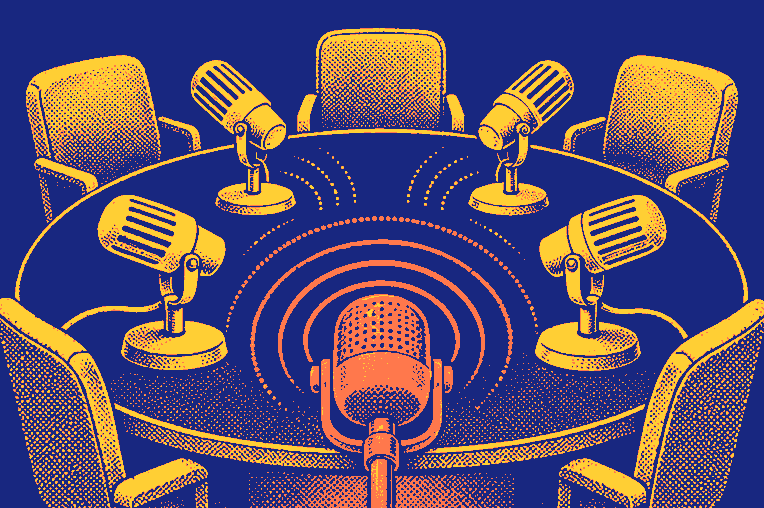
Four yellow microphones face the table while one orange microphone points outwards.
Pluribus is a research project and the basis for my paper, "Don't Merge Carol: Cross-Inhibition and Protected Dissent in Multi-Agent Language Systems." It started with a simple question: when a bunch of AI agents think about a problem together, how should they actually talk to each other, and how do you stop them collapsing into one loud opinion? The classic way multi-agent systems fail is by making all the agents too alike. A hive of identical agents doesn't give you lots of perspectives, it gives you one perspective shouted louder. So the project (named after the Vince Gilligan show) protects a permanent dissenter called Carol, and builds her in so the group can't quietly silence her.
  • Phase 1 is a text-level blackboard with cross-inhibition. Agents push back on weak reasoning, and how much sway each one has goes up or down depending on how good their arguments are. Carol stays no matter what. The takeaway: arguing helps most on judgment calls, not simple facts.
  • Phase 2 is the Latent Resonance Loop. Agents write hidden states into a shared continuous buffer using Behaviourally-Aligned Prefix Codecs, sort out disagreements with a TIES-style merge, and settle the buffer through damped fixed-point iteration.
One early Phase 2 result looked exciting but turned out to be mostly an artifact. Very high cosine similarity in the upper layers was just preserving a shared background direction, not anything useful. Once I calibrated for that, the collective states (at GPT-2 scale and across three 7B model families) came out genuinely distinct from any single agent. On all five test prompts the collective decoded to tokens that weren't in any individual agent's top 10, with mean Jensen-Shannon divergence of 0.08 to 0.13. How useful those states are downstream is more of a mixed bag, with the clearest win on prompts that had real strategic tension. So it's not a sweeping "this is better" claim. It's a concrete demonstration that protected dissent and latent-space conflict resolution can produce shared representations that emerge from the group rather than any one agent. The paper is up on Zenodo. Phase 1 code is at github.com/JeremySNR/pluribus and Phase 2 at github.com/JeremySNR/Pluribus-P2. Read the paper on ZenodoVisit project source ↗

Project archive